Your offer letter has arrived, your CAS is on the way, and somewhere in the small print a university has asked for proof of your immunisations. The problem is that your vaccination card is in Hindi, Mandarin, Yoruba, Polish or Arabic, handwritten by a nurse fifteen years ago.
At Medical Translations UK we prepare a certified translation of vaccination record for UK student visa and enrolment files every intake season, and the first thing worth clearing up is who is actually asking for it.
Most students assume UKVI wants their childhood vaccination card. In nearly all cases, it does not. Understanding the difference between what the Home Office requires, what your university requires and what your new GP will want saves you money and stops you translating documents nobody asked for.
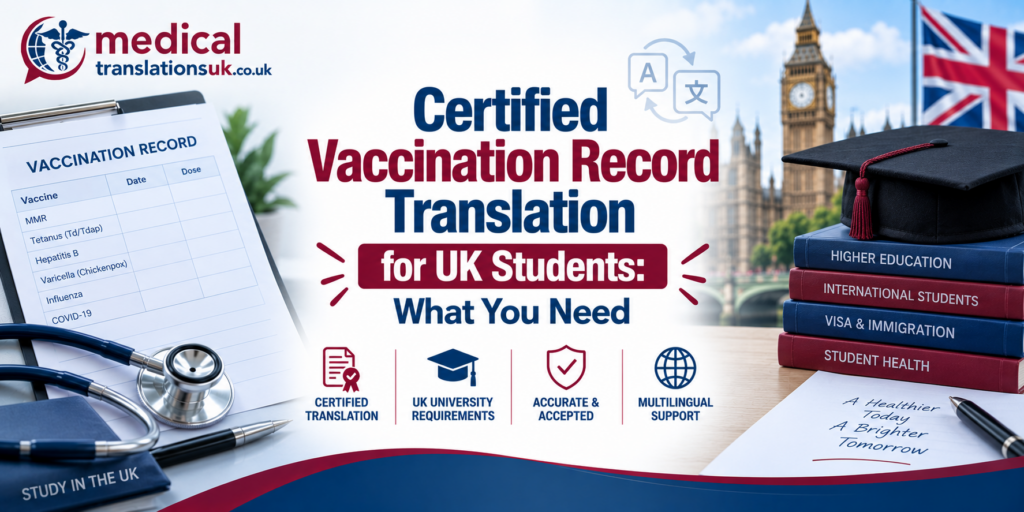
UKVI does not normally ask for a vaccination record with a Student route application — but your university, its occupational health service and your NHS GP often do. Any of these documents in a foreign language must be accompanied by a full certified English translation carrying the translator’s confirmation of accuracy, the date, their full name, signature and contact details.
Does Ukvi Ask For A Vaccination Record With A Student Visa Application?
There are three separate bodies that may want your health paperwork, and they want it for different reasons.
UKVI cares about immigration risk, not childhood immunity. For the Student route, the health document that matters is the tuberculosis test certificate, and only if you have been living in a listed country. Your MMR or polio history is not part of that assessment.
Your university cares about enrolment conditions and public health on campus. Many institutions ask incoming students to declare or evidence their immunisation status, and for courses involving clinical placements this becomes a hard condition of registration rather than a suggestion.
Your GP or university health centre cares about your ongoing care. When you register with the NHS after arrival, an English-readable immunisation history means you are not offered doses you have already had, and any genuine gaps get filled before term.
Translating for the wrong audience is the most common waste of money we see. Confirm in writing with your university’s admissions or occupational health office exactly which documents they need before ordering anything.
Which Health Documents Do You Need For A Uk University Visa?
| Document |
Who normally asks for it |
Certified translation needed? |
| TB test certificate |
UKVI, for applicants from listed countries |
Usually not — approved clinics issue it in English |
| Childhood vaccination card or booklet |
University enrolment, GP registration |
Yes, if not in English |
| MMR vaccination proof |
Universities, especially healthcare courses |
Yes |
| Hepatitis B course record and antibody titre result |
Occupational health, clinical placements |
Yes |
| Varicella (chickenpox) status or serology |
Occupational health, nursing and medicine |
Yes |
| BCG scar certificate or record |
Occupational health for placement students |
Yes |
| Meningitis ACWY vaccination record |
Recommended for students under 25 |
Yes, if issued abroad |
| Fit-to-study or medical clearance letter |
Some universities and scholarship bodies |
Yes |
| Existing prescriptions and treatment summary |
GP registration for ongoing conditions |
Yes |
Requirements differ between universities and between courses at the same university, so treat this as a working list and confirm your own set with the institution.
What Makes A Translation Certified For Ukvi And Uk Universities?
A certified translation is not simply a good English version. Home Office acceptance rests on four specific elements travelling with the document, and universities have largely adopted the same standard.
The translation must carry a written confirmation from the translator that it is an accurate translation of the original. It must show the date the translation was carried out, the translator’s full name and signature, and the contact details of the translator or the translation company so the checking officer can verify it independently. Our certified translators attach this as a signed certificate of translation accuracy on headed paper, cross-referenced to the exact document translated.
Digital signatures and stamps are accepted for most online submissions, but some registry and occupational health departments still ask for a wet-ink stamped hard copy. Ask which one you need before ordering, because a same-day dispatch by post is easy to arrange in advance and stressful to arrange the week before enrolment.
Do I Need My Tb Test Certificate Translated Too?
Usually not, and this is where a lot of applicants overspend. TB test certificates issued for UK visa purposes come from clinics approved by the Home Office, and those clinics issue the certificate in English as standard.
You would only need a TB test certificate translation in unusual situations — for example where a clinic has issued supporting radiology or laboratory notes in the local language, or where a university’s health service asks to see the underlying chest X-ray report rather than the certificate alone. Check the document you were given first. If the wording is already in English, put it straight into your application.
How To Get Your Vaccination Record Translated Step By Step
1. Get written confirmation of what is required. Email your admissions officer or occupational health service and ask which vaccines they need evidenced, whether they accept a scan, and whether the certification must be wet-ink. Keep that email — if a query arises later, it is your proof of what was asked.
2. Collect the complete record, not just the card. Many countries hold immunisation data across a card, a clinic register and a separate serology report. Universities checking Hepatitis B status want the antibody titre result as well as the dose dates, so request both from your clinic while you are still in the country.
3. Scan every page in colour at full size. Vaccination booklets carry meaning in their stamps, coloured pages and margin annotations. A cropped phone photo of the front page forces a query and costs you days.
4. Give your translator your passport spelling. Nurses abroad write names phonetically, and a card reading “Oluwaseun A.” against a passport reading “Oluwaseun Adebayo” needs a translator’s note explaining the match rather than a silent correction.
5. Ask for vaccine names to be handled properly. Brand names differ by country, so a record showing Priorix, Trimovax or Rouvax means little to a UK occupational health nurse until the English version shows both the original brand and the vaccine it corresponds to.
6. Check the draft against what you remember. You know roughly when you had your school jabs. A five-minute read catches a misread date while it is still free to correct.
Before you submit, confirm you have:
- ✔ Every page of the original card or booklet scanned, front and back
- ✔ A certified English translation of each foreign-language page
- ✔ A signed certificate of translation accuracy attached
- ✔ Dates written in full, not in ambiguous numeric format
- ✔ Vaccine brand names carried across with their UK equivalents shown
- ✔ Your name spelled as it appears on your passport and CAS
- ✔ Serology or titre reports included where a course requires them
Why Vaccination Record Translations Get Rejected By Universities
Rejections almost never concern the medicine. They concern what the checker cannot verify.
Vaccine Brand Names Left Untranslated Or Wrongly Matched
A record listing a local combination vaccine tells a UK nurse nothing on its own. Where a brand covers three diseases in one dose, the English version needs to show that clearly, or the student is booked in for repeat vaccinations they do not need.
Missing Dose Dates, Batch Numbers Or Clinic Stamps
Occupational health teams count doses and check intervals. A translation that captures the vaccine names but skips the batch numbers or the clinic’s stamp leaves the record unverifiable, and unverifiable usually means repeat the course.
Only The Front Page Of The Booklet Was Translated
Immunisation booklets carry later doses on inside pages and boosters on the back cover. Partial translations are the single biggest cause of students being told their record is incomplete.
Handwriting Guessed At Instead Of Flagged
Faded ink from a rural clinic twenty years ago is often genuinely unreadable. Our specialists mark it as illegible with a note, because an invented vaccine date in a medical record is far more damaging than an honest gap.
The Applicant Or An Education Agent Did The Translation
Even where the English is perfect, a translation produced by the student, a parent or an agency handling the application fails the independence test. It is the fastest route to a document being sent back.
Frequently Asked Questions About Vaccination Record Translation For Uk Students
Do I Need A Certified Translation Of My Vaccination Card For A Uk Student Visa?
Not for UKVI in most cases, since the Student route does not require childhood immunisation evidence. You will usually need one for your university’s enrolment or occupational health checks, and for registering with an NHS GP.
Can I Translate My Own Vaccination Record For My University?
No. UK institutions require an independent qualified translator, so a version produced by you, a parent or your education agent will normally be refused regardless of accuracy.
Will A Uk University Accept A Google Translate Version Of My Immunisation Record?
No. Machine output carries no certificate of accuracy, no signature and no accountable party, and it regularly mishandles vaccine brand names and handwritten clinic entries.
How Long Does A Certified Vaccination Record Translation Take?
Short cards are commonly completed within one to two working days, with urgent options available. Multi-page booklets with serology reports take longer, so order well before your enrolment deadline.
Do I Need A Notarised Translation For A Uk University Visa?
Rarely. Notarisation confirms the translator’s identity rather than the wording, and it is normally reserved for legal proceedings or overseas official use. Confirm with the institution before paying for it.
Does My Vaccination Record Need An Apostille For The Uk?
Generally not for university enrolment or a Student visa. Apostille legalisation matters when a document must be recognised by a foreign authority, so ask before adding that cost.
What If My Vaccination Record Was Lost Or Never Issued?
Ask your childhood clinic or national health registry for a duplicate, since many countries keep central records. Where nothing exists, universities usually accept serology testing to prove immunity instead, and any foreign lab report will itself need translating.
Do I Need My Vaccination Record Translated To Register With A Gp In The Uk?
You can register without it, but bringing a translated immunisation history stops you being offered doses you have already received and helps the practice complete your NHS record correctly.
I Am Starting A Nursing Or Medicine Course. Is More Evidence Required?
Yes. Clinical placements involve occupational health clearance covering measles, mumps and rubella, Hepatitis B with an antibody titre, varicella status and tuberculosis screening. Each supporting report in a foreign language needs its own certified translation.
Should The Translation Keep The Original Layout Of The Card?
Yes, as closely as possible. Matching the layout lets a nurse hold both versions side by side and follow each dose line for line, which speeds up verification.
Can One Translation Be Used For Both My University And My Gp?
Usually yes, since both accept the same certified format. Ask for an extra stamped hard copy at the time of ordering rather than reordering separately later.
My Documents Are In Two Languages. Does That Cost More?
Each source language is handled by a qualified translator for that language with its own certificate of accuracy, but sending everything together keeps names, dates and vaccine details consistent across the whole file.
Final Thoughts
Enrolment problems rarely come from missing vaccinations. They come from records nobody at the university can read, arriving three days before registration closes. Translating the complete record once, properly, is what keeps your place, your placement and your GP registration on track.
If you are holding a vaccination card and are not sure what your university actually needs, send us a scan and our certified translators will tell you which pages need translating and which do not, before you commit to anything. Get a free check on your student health documents and we will confirm the scope, price and delivery date in writing.