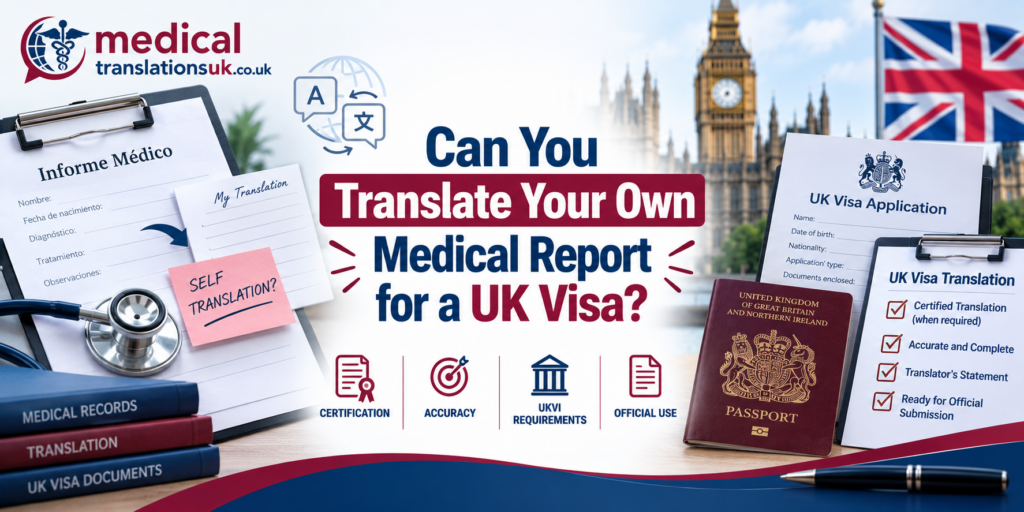
You have the hospital report in your hand. You can read both languages. Typing it out in English would take an hour, and it would cost you nothing. So why pay someone else to do it?
We get asked this every week, and the honest answer saves people a lot of money and a lot of stress. Self-translated medical reports for UKVI are not accepted, and non-certified ones usually are not either. The problem is not your English. It is that the Home Office cannot treat you as an impartial source about your own evidence. At Medical Translations UK, we have reviewed plenty of applications that were built well and then let down by one page of DIY typing. This guide shows you exactly where that page fails, and how to fix it before you press submit.
📌 Quick answer: UKVI needs a full translation from an independent, professional translator, carrying a signed accuracy statement, the date, the translator’s name and working contact details, so a caseworker can verify it. A translation done by you, your spouse, your cousin or a machine fails the independence test, even if every word is correct.
Why Self-Translated Medical Reports For Ukvi Are Refused
Home Office guidance is built around one idea: a caseworker must be able to check the translation without asking you. That is what “independently verifiable” means in practice.
The Independence Test Behind The Rule
When you translate your own TB certificate or hospital letter, three things happen at once:
- ➔ You are both the applicant and the person vouching for the evidence. That is a conflict, not a technicality.
- ➔ There is no third party the caseworker can contact if a diagnosis, date or name looks unclear.
- ➔ Any mistake now looks like a choice rather than an error, especially in medical evidence where one word changes meaning.
Why A Bilingual Family Member Also Fails
Your spouse or cousin may have flawless English. They still cannot certify a document for someone they are connected to, because the connection itself is what breaks the independence requirement.
💡 In our experience, the applicants hit hardest are not the ones with weak English. They are the confident bilingual sponsors who assumed accuracy was the only thing being tested.
Home Office Certified Translation Rules: What Ukvi Checks On A Medical Report
Any document that is not in English or Welsh must be submitted with a full translation. A caseworker looks for a short, fixed set of details. If one is missing, the document can be treated as unsupported evidence.
The Details Every Certified Medical Translation Must Carry
✔ A statement of accuracy confirming the translation is a true and complete version of the original
✔ The date the translation was completed
✔ The translator’s or translation company’s full name and signature
✔ Contact details that actually work, so the translation can be verified
✔ A full translation, not a summary — stamps, footers, handwritten notes and header text included
✔ The original document supplied alongside the English version
What Ukvi Does Not Require, And Where People Overspend
📌 Two points people get wrong: notarisation is generally not required by UKVI for a standard visa application, and an apostille is a separate legalisation step for the original document, not for the translation. Requirements can vary by route and by case, so confirm the exact list for your visa type on official guidance before you submit.
Certified Vs Non-Certified Vs Notarised Medical Translation Compared
This table settles most of the confusion we hear on the phone.
| Requirement |
Self-translated / family |
Non-certified professional |
Certified translation |
Notarised translation |
| Accepted by UKVI |
No |
Usually no |
Yes |
Yes, but rarely needed |
| Accuracy statement |
Missing |
Often missing |
Included |
Included |
| Independent source |
No |
Yes |
Yes |
Yes |
| Caseworker can verify it |
No |
Sometimes |
Yes |
Yes |
| Extra legal step |
None |
None |
None |
Notary confirms signature |
| Typical use |
Nothing official |
Personal reading only |
Visa, settlement, asylum, ILR |
Courts, some embassies |
How To Read This Table For Your Own Route
➔ For most visa, settlement and citizenship applications, the certified column is your target. Paying for notarisation you do not need is as costly a mistake as translating it yourself.
Which Medical Documents Cause The Most Refusals And Delays
Not every medical page carries equal risk. These are the ones we see cause problems most often.
Tb Certificates, Hospital Reports And Vaccination Records
- TB test certificates. Certificates from a Home Office-approved clinic are usually issued in English already. If yours is not, it needs a certified translation, and it must sit inside the six-month validity window you are applying within.
- Hospital reports and discharge summaries. Long, technical, full of abbreviations. This is where DIY translations quietly drop a line or soften a diagnosis.
- Vaccination records. Dose names and dates must line up exactly. Reordered dates look like a different record.
- Lab and blood test reports. Reference ranges and units get mistyped constantly when someone is retyping at midnight.
Psychiatric Reports In Asylum And Human-Rights Cases
Here the translation is the evidence. A softened phrase or a missing clinical term can weaken the entire claim, which is why these files should never be handled informally.
When the document is a clinical report rather than a short certificate, we handle it through our medical report translation service, because the terminology risk is far higher than on a one-page certificate.
How To Replace A Self-Translated Medical Report Before You Submit
Here is the order we recommend to clients working against a deadline.
- Sort your documents by language, not by importance. Pull out everything that is not in English or Welsh. People routinely forget the stamp on the back page or the clinic’s letterhead.
- Check what is already in English. Some overseas clinics issue bilingual certificates. If the whole document is already in English, you do not need a translation, and you should not pay for one.
- Lock your name spelling first. Decide the exact spelling that appears on your passport and application form, then give it to the translator before work starts. Mismatched transliteration across your passport, form and medical file is one of the most common triggers for extra questions.
- Send the clearest full scan you have. Not a cropped photo. Edges, stamps and reverse sides matter, because a partial scan produces a partial translation.
- Check the finished translation side by side with the original. Confirm dates, dosages, your date of birth and the doctor’s name. You know your own record better than anyone, and this is where your language skills genuinely help.
- Submit the original and the translation together. A translation with no source document to compare against gives the caseworker nothing to verify.
Your Before-You-Upload Checklist
✔ Every non-English page translated in full
✔ Accuracy statement, date, name, signature and contact details present
✔ Name spelling identical across passport, form and translation
✔ Original scans attached beside each translation
✔ TB certificate still inside its validity window
✔ No machine-translated pages left in the bundle
📌 For shorter answers on ordering, layout matching and extra certified copies, our medical translation FAQs cover the practical side.
Already Submitted A Self-Translated Or Non-Certified Medical Report?
Do not panic, and do not sit still either.
- If your application is not yet decided, get a compliant certified version prepared straight away. Many routes allow further documents, and a caseworker may request more information before deciding.
- If you have received a request for further evidence, treat the deadline as immovable. Order the same day and reply inside the window given.
- If you were refused over evidence, speak to a regulated immigration adviser about your options before reapplying, so the fresh application does not repeat the error.
We can usually turn a certified medical translation around in 24 to 48 hours, and we handle every file under strict confidentiality, because health records are sensitive personal data and deserve to be treated that way.
Frequently Asked Questions About Self-Translated Medical Reports For Ukvi
Can I Translate My Own Medical Report For A Uk Visa If I Am Fluent?
No. Fluency is not the issue. The Home Office needs an impartial third party who can be contacted to verify the work, and you cannot be that party for your own application.
Does The Home Office Accept Non-Certified Medical Translations?
Generally no. Without a signed accuracy statement, a date and working contact details, a caseworker has no way to verify the translation, so it can be treated as unsupported evidence.
Can A Family Member Translate Documents For Ukvi?
No. A spouse, parent or relative is not an independent source, even if they are a qualified linguist. The connection to you is what disqualifies the certification.
Is Google Translate Accepted For A Uk Visa Application?
No. Machine output carries no accuracy statement, no signature and no accountable person behind it. On medical text it also mishandles abbreviations and drug names.
Who Can Certify A Translation For The Home Office?
A professional translator or translation company independent of you. Membership of a recognised body such as CIOL, ITI or the ATC adds credibility, though the core requirement is the certification details themselves.
Does My Medical Translation Need To Be Notarised For Ukvi?
Usually not. Notarisation confirms a signature, not the wording, and standard visa routes generally ask only for a certified translation. Confirm your specific route before paying extra.
Does My Tb Test Certificate Need Translating?
Only if it is not already in English. Certificates from Home Office-approved clinics are commonly issued in English, so check before ordering anything.
Do I Need An Apostille On My Medical Documents?
An apostille legalises the original document for use abroad and is separate from translation. Whether you need one depends on your case and the issuing country.
Can I Translate Only The Relevant Part Of A Long Hospital File?
No. Partial or summarised translations are not acceptable. The English version must reflect the whole document, including stamps and marginal notes.
Do Certified Medical Translations Expire?
The translation itself does not expire, but the underlying document might. A TB certificate, for example, has its own validity window you must apply within.
Are My Medical Records Kept Confidential During Translation?
They should be. We restrict access to the specialists working on your file and handle all health data in line with UK data protection rules.
Final Thoughts: Do Not Let One Page Undo Your Application
You have already done the hard part — the clinic appointment, the paperwork, the fee. A self-translated medical report is the one shortcut that quietly puts all of it at risk, and it is also the cheapest thing on your list to fix.
If you are unsure whether your document even needs translating, ask before you spend anything. Send us your medical file and we will tell you honestly what UKVI needs and what you can skip.
➔ Get your medical document checked before you submit — we will review it and come back with a clear answer and a quote.