You have flown home with a folder of hospital paperwork in Spanish, Turkish, Polish or Arabic, and your insurer has now asked for it “in English”. At Medical Translations UK we prepare this exact bundle every week, and there is one thing worth knowing before you post anything: a discharge summary translation for insurance claim purposes is almost never accepted on its own.
A claims assessor is not trying to read your medical story. They are trying to match three separate proofs — what was wrong with you, what was done about it, and what it actually cost. Your discharge summary only answers the first two. This guide sets out the full set of papers UK insurers ask for, which parts of each one must be translated, and the small formatting errors that quietly push a file into the “further information required” pile for another six weeks.
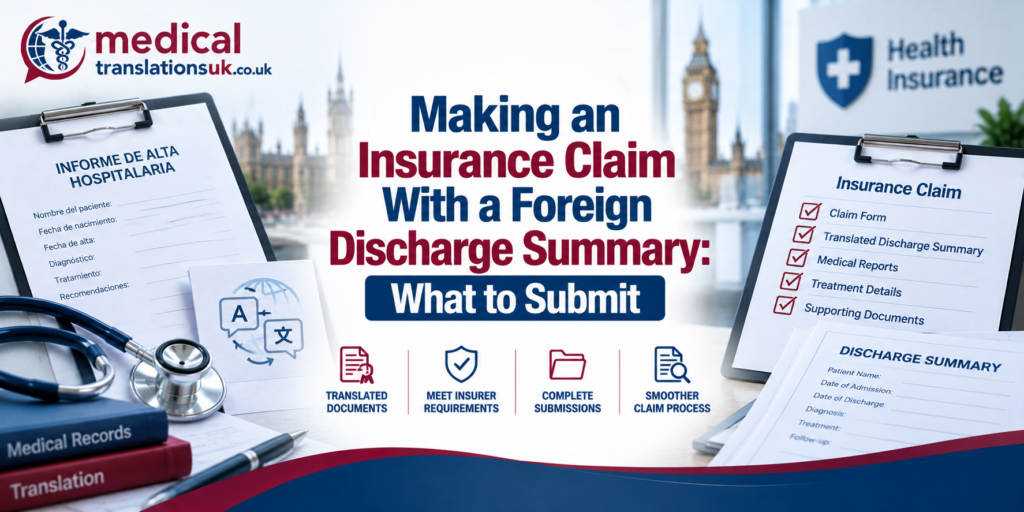
Most UK insurers want the translated discharge summary plus the itemised hospital invoice, proof of payment, the treating doctor’s report, prescriptions and receipts, your completed claim form, and a signed medical authority form. Every foreign-language document in that set needs a certified English translation with a signed certificate of translation accuracy.
Why Uk Insurers Ask For More Than The Discharge Summary Alone
A discharge summary tells an assessor that you were admitted, diagnosed and treated. It rarely tells them the four things they are actually paid to verify.
They need to see when your symptoms first started, because that date decides whether the condition counts as pre-existing under your policy. They need line-by-line costs, because a lump-sum figure cannot be checked against what your cover allows. They need proof you paid, since most travel policies reimburse rather than settle directly. And they need to confirm the treatment was medically necessary rather than elective, which usually comes from the treating doctor, not the discharge note.
Send only the discharge summary and the assessor has no choice but to write back asking for the rest. That single email exchange is where most delays come from.
[Image: insurance-claim-document-bundle.jpg — Alt: “A translated discharge summary, itemised hospital invoice and receipts prepared for a UK insurance claim.” Caption: What a complete claim bundle looks like before it goes to the assessor.]
What Documents Do I Need To Send With My Insurance Claim?
Here is the bundle our certified translators are usually asked to prepare for a UK insurer, and what each item is doing in the file.
| Document |
Why the assessor wants it |
Needs translation? |
| Hospital discharge summary |
Diagnosis, admission and discharge dates, treatment given |
Yes — in full |
| Itemised hospital invoice |
Breaks the bill into rooms, drugs, tests and fees |
Yes |
| Proof of payment (receipts, card statement) |
Shows the money left your account |
Usually only the headings |
| Treating doctor’s report or medical certificate |
Confirms necessity and the date symptoms began |
Yes |
| Prescriptions and pharmacy receipts |
Supports medication costs claimed |
Yes |
| Admission or emergency department record |
Shows first point of contact abroad |
Yes, where dates are disputed |
| Lab results, scans and radiology reports |
Backs the diagnosis if the insurer queries it |
Yes, if referenced |
| Police or accident report |
Required for injury, road traffic and assault claims |
Yes |
| Repatriation or air ambulance paperwork |
Justifies transport and escort costs |
Yes |
| Completed claim form |
The insurer’s own document |
No |
| Policy schedule or certificate of insurance |
Identifies your level of cover |
No |
| Proof of travel (bookings, boarding passes) |
Confirms you were abroad within the cover dates |
No |
| Signed medical authority or consent form |
Lets the insurer request your UK GP records |
No |
Policies differ widely, so treat this as the working list rather than a rule. Read your policy wording and confirm the exact set with your insurer before you send anything, especially the deadline for submitting a claim — many policies close the window within a fixed number of days of treatment.
Which Parts Of A Foreign Discharge Summary Must Be Translated?
This is where most rejected files go wrong. An insurer needs the English version to be a mirror of the original, not a summary of the useful bits.
Everything visible on the page is translated: the hospital letterhead, department name, ward, the body text, footers, reference numbers and any handwritten additions in the margins. Official stamps and seals are described rather than skipped, so the assessor can see a stamp existed and what it said. The doctor’s signature block, registration number and specialty are carried across, because that is what proves a qualified clinician signed it.
Clinical codes such as ICD-10 entries are kept exactly as printed, never “translated” into plain English, since the insurer’s own system reads those codes. Where handwriting or a faded stamp genuinely cannot be read, our specialists mark it as illegible rather than guessing — an invented word in a medical record is far more damaging to a claim than an honest gap. The layout is matched to the original as closely as possible so the assessor can hold both versions side by side and follow them line for line.
Does An Insurance Claim Need A Certified Or Notarised Translation?
For an ordinary reimbursement claim, UK insurers ask for a certified translation. That means the English version arrives with a signed certificate of translation accuracy stating that it is a true and complete rendering of the original, along with the translator’s name, signature, date, credentials and contact details, plus the agency’s details so the insurer can verify it independently.
Notarised medical translation is a further step, where a Notary Public confirms the translator’s identity and signature — not the wording. You generally only need it if your claim moves into legal territory: a dispute heading for court, an overseas legal action against a hospital or foreign insurer, or a case where a consulate or a foreign authority is involved. Paying for notarisation on a routine travel claim adds cost and days for no benefit, so ask your insurer in writing which level they require before ordering.
Why Do Uk Insurers Reject Translated Medical Records?
Rejections are rarely about the medicine. They are almost always about consistency.
The Name On The Records Does Not Match Your Passport
Foreign hospitals transliterate names their own way, and a policy in the name “Mohammed Al-Rashid” against records reading “Muhammad Alrashid” reads as two different people to an assessor. The translation should carry the spelling exactly as it appears on the original, with a translator’s note explaining the variant against your passport.
The Dates Have Been Written In The Wrong Format
An admission on 04/09 could be April or September depending on the country. Our certified translators write dates out in full — 4 September 2025 — so there is no room for an assessor to read a treatment date as falling outside your cover.
The Invoice Currency Has Been Converted
A translation is not a conversion. If the bill says 48,500 TRY, that is what the English version says. Insurers apply their own exchange rate on the date of treatment, and a helpfully pre-converted pound figure looks like the document has been altered.
Only Part Of The Document Was Translated
Sending three translated pages out of a seven-page record invites the assessor to assume the missing pages contain something unhelpful, such as an earlier symptom date. Partial bundles are a common trigger for pre-existing condition queries.
A Relative Or The Policyholder Translated It
Even if the English is perfect, a translation produced by the claimant, a family member or a bilingual friend fails the independence test almost every insurer applies. It is the single fastest way to have a file returned.
[Image: certificate-of-translation-accuracy.jpg — Alt: “A signed certificate of translation accuracy attached to a translated hospital discharge summary.” Caption: The signed accuracy statement insurers look for on every translated medical document.]
How To Prepare Your Claim Bundle Step By Step
1. Ask your insurer for their document list in writing. Phone advice is easily misremembered and cannot be produced later if the claim is queried. An email or portal message gives you a record of exactly what was requested and which certification level they need.
2. Gather the originals before you leave the hospital abroad, if you still can. Discharge summaries, itemised invoices and stamped receipts are far harder to obtain once you are back in the UK. Where you have already travelled home, email the hospital’s international patients or billing office and request certified copies.
3. Scan every page at full size, in colour. Stamps, seals and coloured letterheads carry meaning, and a greyscale phone photo of a corner of the page slows the work down and can force a query back to you.
4. Send the whole set for translation at once. Names, dates and diagnoses must read identically across the discharge summary, invoice and doctor’s report. Translating documents piecemeal, weeks apart, is how inconsistencies creep in.
5. Flag the spellings that matter. Tell your translator how your name appears on your passport and policy, and mention any variant used abroad. Our specialists then apply that spelling consistently and add a note where the original differs.
6. Check the draft against your own records before submission. You know your admission date and what you paid better than anyone. A five-minute read of the English version catches issues while they are still free to fix.
Before you submit, confirm you have:
- ✔ The original foreign-language documents retained safely
- ✔ A certified English translation of every foreign-language page
- ✔ A signed certificate of translation accuracy attached to each translation
- ✔ Names spelled consistently across all documents
- ✔ Dates written in full, and currency left unconverted
- ✔ The insurer’s claim form completed and the medical authority form signed
- ✔ A complete copy of the whole bundle kept for your own records
Frequently Asked Questions About Discharge Summary Translation For Insurance Claims
Can I Translate My Own Hospital Discharge Summary For An Insurance Claim?
No. UK insurers require translations from an independent qualified translator, so a version produced by you, a relative or a bilingual colleague will normally be rejected regardless of quality.
Will My Insurer Accept A Google Translate Version Of My Medical Records?
No. Machine output carries no certificate of accuracy, no accountable signature and no professional liability, and it regularly mistranslates drug names and clinical terms. Insurers treat it as unverified.
Do I Need To Send The Original Foreign Documents Or Just The Translation?
Insurers almost always want both, presented together, so the assessor can compare them. Keep your originals and send certified copies where possible, and confirm the insurer’s preference before posting anything irreplaceable.
How Long Does A Certified Translation For An Insurance Claim Take?
Most short bundles are completed within a couple of working days, with urgent options available. Long hospital files with scans and multiple invoices take longer, so send everything as early in your claim window as you can.
Does An Itemised Hospital Bill Really Need Translating Too?
Yes, in almost all cases. The invoice is what the reimbursement figure is calculated from, and an assessor cannot approve line items they cannot read.
What If Part Of My Discharge Summary Is Handwritten And Unreadable?
The illegible section is marked as such in the English version rather than guessed at. If that part is important to the claim, ask the treating hospital for a typed copy or a clarifying letter.
Do Translated Medical Documents For Insurance Claims Expire?
The translation itself does not expire, but insurers work to strict claim deadlines set out in your policy wording. Check that window as soon as you get home, since it often starts from the date of treatment rather than the date you return.
Will I Need An Apostille On My Translated Medical Records?
Rarely for a UK insurance claim. Apostille legalisation matters when documents cross borders for official or legal use abroad, so ask your insurer directly before paying for it.
My Insurer Says My Condition Was Pre-Existing. Can A Translation Help?
It can, where the original records contain a symptom onset date, a first consultation date or a clinician’s note that a partial translation left out. A complete, certified translation of the full record gives you the evidence to respond properly.
Who Pays For The Translation Of Medical Documents In An Insurance Claim?
Usually the claimant pays upfront. Some policies reimburse reasonable administrative costs as part of the claim, so check your wording and keep the translation invoice with your paperwork.
Can My Solicitor Use The Same Translation If The Claim Goes Further?
Often yes, though court proceedings can call for a court-admissible or notarised version. Tell us at the outset if legal action is possible, so the certification is prepared with that in mind.
I Was Treated In More Than One Country. Does Each Set Need Separate Handling?
Each set is translated from its own source language with its own certificate of accuracy, but they should be prepared together so names, dates and diagnoses stay consistent across the whole claim.
Final Thoughts
An insurance claim is rarely lost on the medicine. It is lost on a name spelled two ways, a date an assessor reads as falling outside cover, or an invoice nobody could check. Getting the full bundle translated properly, once, is the difference between a claim settled in weeks and one that drifts for months.
If you are holding a foreign discharge summary and are not sure what your insurer will want alongside it, send us the file and our certified translators will tell you exactly what needs translating and what does not — before you spend anything. Send your hospital documents for a free claim review and we will come back to you with a clear scope, price and delivery time.